How to Check If a Wall Is Plumb (Perfectly Vertical)
A plumb wall is vertical, straight up and down, 90 degrees off the floor. Checking plumb is not the same as checking level. Level means horizontal. Plumb means vertical. Your phone does both. In Plumb mode, Spirit Level Pro reads how many degrees off vertical the wall sits, so you can write the number down and decide whether it matters for the job in front of you.
Key Takeaways
- Plumb means vertical. Level means horizontal. You measure them differently and they matter for different jobs.
- Old walls lean. A house built before 1950 is often 1/4" to 3/4" out of plumb over 8 feet, and that is normal.
- Check at three heights (bottom, middle, top) to tell a lean apart from a bow.
- Finish work tolerates up to 1/4" per 8 feet (0.17°). Tile is tighter at 3/16" per 10 feet.
- Plumb mode reads one axis only, which is all a vertical surface needs.
Level vs plumb: what's the difference?
Level and plumb are two different planes. Level is horizontal, parallel to the horizon. Plumb is vertical, straight up and down. A countertop should be level. A wall should be plumb. People mix the two up all the time, and it causes real trouble. A wall can sit dead level along the floor and still lean out at the top. The floor line looks right and the wall is still not plumb.
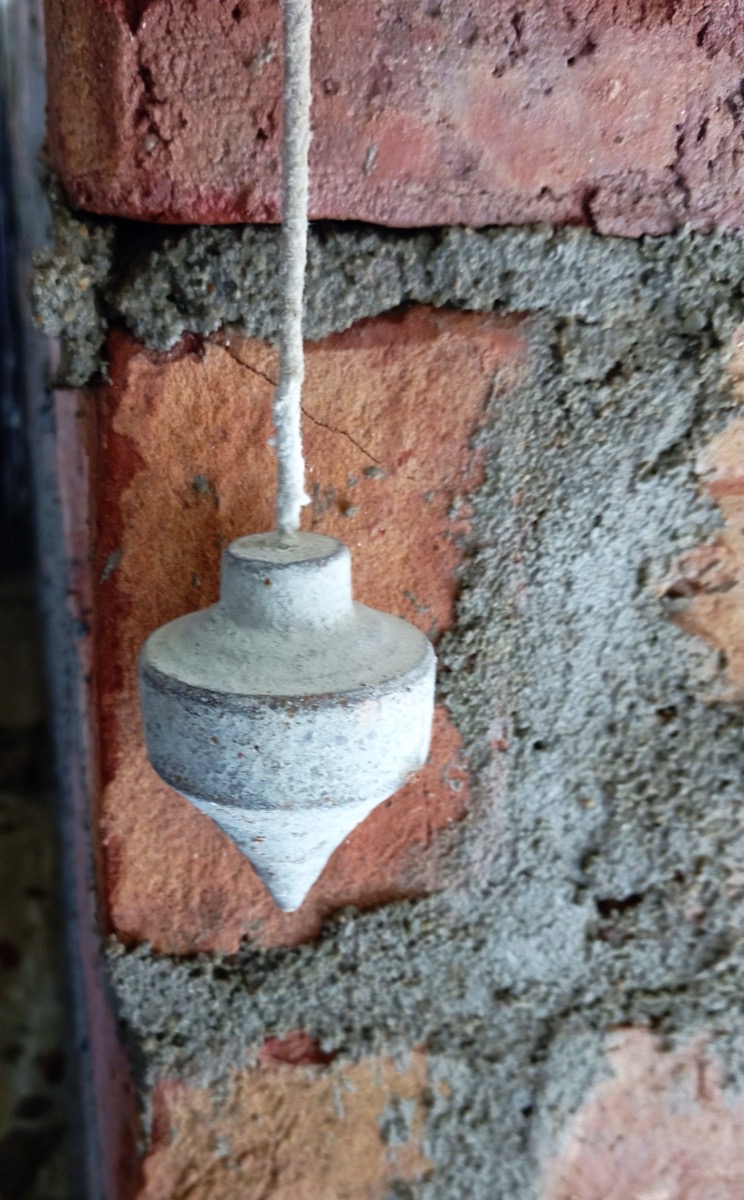
The word plumb comes from plumbum, the Latin for lead. Old builders hung a lead weight on a string, a plumb bob, and let gravity pull it into a true vertical line. A phone does the same job with an accelerometer. Gravity sets vertical, and it does not care what the surface behind it is doing.
Why a wall can be level at the bottom but not plumb
Picture a wall that meets the floor at a clean right angle but leans 2 inches out at the ceiling. Along the floor it is level. The wall itself is not plumb, because it tilts away from vertical as it climbs. Checking the floor line tells you nothing about that. You have to read the wall face directly.
This bites you in practice. A wall that leans into the room 1/2 inch over 8 feet leaves a gap behind a tall bookcase. Lean it 3/4 inch over 8 feet and tiling gets hard. You end up cutting every course at a slight angle to chase it, and the grout lines fan out where anyone can see them.
When does wall plumb actually matter?
Not every job needs a plumb wall. A wall that is 1/4 inch out over 8 feet is nearly invisible and does not matter for painting or hanging things. Some jobs are fussy about it though, and a two-minute check up front saves you tearing work out later.
Check plumb before you start any of these:
- Tiling a wall. Tile does not forgive. Each course sits on the one below it, so if you start off vertical the error grows row by row until you can see it. Wall tile wants 3/16 inch per 10 feet (about 0.11°), tighter than most finish work.
- Fitting floor-to-ceiling wardrobes or bookcases. A tall unit built square against a leaning wall leaves a gap at the top or the bottom. You scribe or shim the sides to match the wall.
- Hanging door and window frames. Set a frame in an out-of-plumb opening and the door swings open or shut on its own. Door frames want 1/4 inch per 4 feet (0.36°). Check before you hang the door, not after.
- Wainscoting or paneling. A horizontal panel joint running into a leaning wall looks like it slopes. Know the wall's lean before you cut the first panel.
- Framing a new wall inside a room. New framing has to be plumb no matter what the old walls do. Check the old walls first so you know what you are working next to.
How do you check wall plumb with your phone?
Checking a wall with your phone takes about a minute and a half and gives you a number in degrees, not the rough yes-or-no of a plumb bob. A phone accelerometer reads to better than a tenth of a degree once you calibrate it, which is finer than you can read off a swinging bob.
- Switch to Plumb mode. Open Spirit Level Pro and tap the mode toggle. Surface mode is the round vial and reads two axes. Plumb mode is the tall vial and reads pitch only, which is what you want on a vertical face. Roll does not matter here.
- Hold the phone flat against the wall. Press the back or a long edge flat to the surface. Do not hold it out in front of the wall in mid-air, or you read the angle of your hand instead of the wall. Hold still for two seconds and let the number settle.
- Read it at three heights. Take one about 12 inches off the floor, one at mid-height, and one about 12 inches down from the ceiling. Write all three down, or save them to the journal under a project name if you are documenting a renovation. Three readings tell you far more than one.
If the three readings are close, say 0.4°, 0.5°, 0.4°, the wall leans the same way all the way up. If the middle one is way off the ends, say 0.2°, 1.1°, 0.3°, the wall bows out or in through the middle. That is a different problem and it needs a different fix.
The sound helps here. Press the phone to the wall and listen. The steady level tone kicks in once the reading hits your tolerance. Slide the phone up and down the wall and let your ear track it, which is handy when the screen is flat against the wall and facing away from you.
What are acceptable plumb tolerances?
Tolerances change with the trade and the material going on the wall. The rule of thumb is simple: the tighter the finish, the tighter the wall has to be underneath it. If a wall is worse than tile tolerance, you shim the substrate flat first. You do not just live with it and hope the tile hides it.
| Task | Linear Tolerance | Angular Approx. | Source |
|---|---|---|---|
| Residential finish work | 1/4" per 8 ft | ~0.17° | NKBA, 2023 |
| Rough framing | 3/8" per 8 ft | ~0.27° | IRC Section R602 |
| Wall tile work | 3/16" per 10 ft | ~0.11° | TCNA Handbook, 2023 |
| Door / window frame | 1/4" per 4 ft | ~0.36° | NFPA 80 / NKBA |
Spirit Level Pro's Finish preset (±0.3°) sits inside the residential finish standard. The Tile preset (±0.2°) works for wall tile but runs a touch loose against the tile spec over longer walls. For tiling, measure the full wall height and work out the deviation at the top directly: degrees × wall height in inches × 0.01745 gives you the inches of lean at the top.
What should you do when a wall is out of plumb?
It depends on how far out it is, what you are doing to the wall, and whether it is an old building where a leaning wall is just how they were built. A house built before 1950 is often 1/4 inch to 3/4 inch out of plumb over 8 feet. For the way those walls were put up, that is normal, not a fault. Half an inch over 8 feet is common in a pre-war house. A wall inside 1/4 inch is the rare one.
Furring strips: the fix for a straight lean
When a wall leans the same all the way up, same reading top, middle, and bottom, furring strips sort it out. Fix vertical strips of wood or metal to the wall and shim them at the top or bottom until their faces line up plumb. Then your finish goes on the furring, not the wall. This eats 3/4 inch to 1.5 inches of room depth, which you notice in a small room.
Thin tapered strips handle a small lean, 1/4 inch to 1/2 inch over 8 feet, without stealing much depth. For more than 1/2 inch, go to 1x3 or 1x4 furring and shim each fixing point on its own.
Skim coat and plaster: the fix for small leans
A wall up to about 3/8 inch out over 8 feet often comes back into tolerance under a skim coat of plaster or setting compound, laid thick at the low end and feathered to nothing at the other. It adds no depth you can see. It takes a bit of plastering skill to get flat, but it is the least invasive way to true up a small lean on a wall you want to tile.
When to accept the lean
Sometimes the right call is to leave it alone and build around it. Hanging a wardrobe? Build it square and scribe the sides to the wall. Fitting skirting? Mark the angle and cut to it. Painting? Half an inch over 8 feet vanishes under paint. Work with the wall.

Does checking one point tell you everything about the wall?
No, and this is the thing most people get wrong about checking plumb. One reading at one height tells you the lean. It tells you nothing about a bow. A wall can read 0.0° at the top and 0.0° at the bottom, plumb at both ends, and still bulge 1/2 inch out through the middle. You never see that bow unless you read the middle.
The three-point rule: One reading tells you the lean. Read the bottom, middle, and top to catch a bow, which is harder to fix than a straight lean. A bow means grinding back the high spots or building out the hollows. A lean you can fix in one uniform go with furring or plaster.
How to tell a lean from a bow
Read three heights and note the numbers. If all three land within 0.1° to 0.2° of each other, the wall leans the same way all the way up. If the middle reading is more than 0.3° off the top and bottom, the wall bows.
Bows turn up more than people expect in old masonry. A single-skin brick wall from the early 1900s can develop a slow outward bow at mid-height, pushed there by the floor joists and decades of the brick drying and wetting. The only way to catch it is the three-point read.
A straight lean is easy to correct. A bow is not. The face is neither flat nor evenly angled, it is curved. Furring over a bow means shimming each fixing point on its own to build a flat face. For a bad bow, over 1/2 inch at mid-height, get a builder to look at it before you commit to a finish.
Writing down wall plumb for a renovation
If you are running a full renovation, read every wall for plumb before any work starts. Save them to a project in the journal and label each one by wall, like "North wall bottom", "North wall mid", "North wall top". When the plasterer or tiler turns up and asks about the walls, you hand them numbers instead of a guess. That lets the tiler decide up front whether to skim, fur, or tile straight onto it, rather than finding out after the adhesive is mixed.
Check and document wall plumb with Spirit Level Pro — free, no download needed.
Open Spirit Level ProFrequently asked questions
What does it mean for a wall to be plumb?
A plumb wall is vertical, 90 degrees off a level floor. The word comes from plumbum, Latin for lead, because old builders hung a lead weight on a string to find true vertical. Most house walls lean a little off plumb. The real question is whether the lean matters for the job you are doing.
How much out of plumb is acceptable?
It depends on the job. Finish work allows 1/4" per 8 feet (about 0.17°). Rough framing allows 3/8" per 8 feet (about 0.27°). Wall tile wants 3/16" per 10 feet. Door and window frames allow 1/4" per 4 feet (about 0.36°). Old houses beat all of these, so the question is whether your finish material can swallow the difference.
Can I use my phone to check if a wall is plumb?
Yes. Hold the phone flat to the wall in Plumb mode and it reads how many degrees off vertical the wall sits. Read three heights: 12 inches off the floor, the middle, and 12 inches down from the ceiling. Three matching numbers mean a straight lean. A different number in the middle means the wall bows, which is harder to fix.
What is the difference between a wall that leans and a wall that bows?
A leaning wall tilts the same way all the way up. One reading tells you the story. A bowing wall curves out or in through the middle while reading plumb at the top and bottom. You only catch a bow by reading three heights. A bow is harder to fix than a lean, because a single furring strip or skim coat will not true up a curve.