How to Install Kitchen Cabinets Level: A Complete Guide
Installing cabinets starts with one job: find the highest point on the floor, snap a level line off it, and hang every cabinet to that single line. That is the whole trick. The floor is never flat, the wall is never plumb, and if you get the reference line wrong the error carries down the run and shows up in the countertop. I have redone enough kitchens where someone started at the wrong corner to know it is worth the extra ten minutes up front.
Key Takeaways
- Find the floor's highest point first. The whole reference line is set from there.
- A small tilt on a wide base cabinet shows up as a slanted countertop edge or a gap at the toe kick, so keep each face tight.
- Aim for about a third of a degree per cabinet face. That is well inside what the eye can catch.
- Proximity audio lets you hold the cabinet to the wall with both hands and check level by ear.
- The ledger board method is the safest way to hang upper cabinets on your own.
Why you start from the high point
The highest point on the floor is the one thing you cannot shim away, so it sets the rule for everything else. Start there and every cabinet either sits straight on the floor or gets shimmed up to the line. Start at the low point and you have to shim every other cabinet in the run, including the one back at the high spot, which would need a shim of nothing and rock on the uneven floor. So the high point wins by default.
Kitchen floors are rarely flat. On an older house I expect somewhere between 3/8 and 3/4 inch of variation across a ten-foot run, and that is enough to pull doors out of line and open a gap at the countertop seam if you ignore it. The reference line soaks all of that up.
How to find the high point
Grab a straightedge at least six feet long. A long spirit level or a factory-straight piece of lumber both do the job. Lay it across the floor along the cabinet run and turn it a few different ways. Where the gap under the straightedge closes to nothing is your high point. Mark it in pencil.
A faster way is to open Spirit Level Pro on your phone and slide it slowly along the floor in Surface mode. Watch the pitch reading. The spot where pitch reads closest to zero is your high point. Note the reading at each end of the run while you are at it. The difference tells you how much shim you will need at the low end.

Setting the reference line
From the high point, measure up 34.5 inches, which is the standard base cabinet height, and make a mark. Snap a chalk line or run a laser across all the studs in the run to carry that mark along the wall. That horizontal line is your baseline. Every base cabinet gets shimmed up to it from below. You never bring one down to meet it.
For the uppers, measure up from that same baseline. Finished counter height is 36 inches: a 34.5-inch box plus a 1.5-inch countertop. Add 18 inches of clearance from the counter to the bottom of the upper cabinet and the upper bottom line lands at 54 inches above the floor's high point. A standard 30-inch upper then tops out at 84 inches.
How to mark the wall layout lines
Clear lines on the wall save you from measuring the same thing over and over. Snap three horizontal lines: the base cabinet top at 34.5 inches, the upper cabinet bottom at 54, and the upper cabinet top at 84. Mark every stud with a vertical line. Use a chalk line for the horizontals. It is faster and straighter than a pencil over a long run.
Snap the base cabinet line first. Then measure up from that snapped line for the two upper lines. Do not start fresh from the floor each time. Any error in the floor-to-34.5-inch measurement will follow you up the wall if you re-measure from the floor for every line.
Locating and marking studs
Run a stud finder, then confirm with a small nail through the drywall. Mark each stud face with a light pencil line from the floor up past the upper cabinet line. Circle each mark so it does not disappear behind a cabinet before you have screwed into it. Studs usually sit 16 inches on center, but older houses wander, so check every one.
Pro tip: Draw your stud marks above the upper cabinet line, not behind where the cabinets sit. Once a cabinet is against the wall you cannot see the marks. A line up high that you can spot from a step ladder saves you from hunting for studs halfway through.
Tools and materials
Get everything out before you start. Nothing wastes time like the first cabinet hanging loose off two screws while you dig through the van for a drill bit.
- Spirit level, or Spirit Level Pro on your phone for checking level and plumb as you go
- Stud finder and a few small nails to confirm
- Chalk line for snapping straight lines over long runs
- Drill and driver, cordless, with a No. 2 Phillips and a long 3/32-inch pilot bit
- 3-inch wood screws for going through the cabinet back into studs
- Composite shims, which hold their thickness better than wood over time
- Clamps for pulling adjacent cabinets together while you screw the face frames
- Ledger board, a straight 1x4 or 1x3 to support upper cabinets while you hang them
- Pencil and tape measure
- Cardboard or a drop cloth to keep cabinet edges off the floor
- Oscillating multi-tool or utility knife for trimming shims flush
How to install base cabinets level and plumb
Base cabinets go in the same order every time: start at a corner, check level and plumb, shim up to the reference line, screw into studs, then work outward. The Kitchen Cabinet Manufacturers Association allows only about 1/32 inch of misalignment between face frames, which is tight. Working to roughly a third of a degree on each face keeps you well inside that. Set a Finish tolerance preset on your level and let it tell you when you are there.
- Start at the corner cabinet. Set it in place but do not fix it yet. Check that the top front rail is level left to right and the side panel is plumb front to back. Those two readings show you where the shims go.
- Check both axes. Set your phone on the cabinet's top rail in Surface mode and read pitch and roll together. Pitch is the front-to-back tilt. Roll is the left-to-right tilt. Get both inside ±0.5° before you shim to the line.
- Shim to the reference line. Slide composite shims under the base until the top rail meets your 34.5-inch chalk line. Shim the corners first, then under the middle if the cabinet rocks. Re-check level after each shim.
- Screw into studs. Drive 3-inch screws through the mounting rail into the studs, two per stud, one high and one low. Do not crank them. Uneven screws will pull a cabinet back out of level.
- Move to the next cabinet. Butt it against the first, clamp the face frames together, and check that they sit flush. This is where the Finish preset earns its keep. A small step between two face frames reads as a visible ridge.
- Screw the face frames together. Drive a 1.25-inch face frame screw through the first cabinet's stile into the second. Take the clamp off and check level once more.
Handling the shim gap at the floor
Shimming leaves a gap between the cabinet base and the floor. Do not trim the shims yet. Wait until every base cabinet is in and level. Then score each shim with a utility knife and snap it off. The toe kick hides the rest. If the gap still shows above the toe kick, a strip of scribe molding covers it cleanly.
Using proximity audio when both hands are busy
Holding a cabinet to the wall with one hand and driving screws with the other leaves nothing to watch the screen with. That is what proximity audio is for. Set the phone on the cabinet top in Surface mode with the sound on. The beeps slow down as you drift off level and speed up as you close in, then go to a steady tone when you are there. You never have to look up.

How to install upper cabinets on your own
Uppers are harder than base work. They are heavy, awkward, and have to be held at the right height while you drive screws. Plenty of installers hang them as a two-person job for that reason. A ledger board lets one person do it safely, and honestly I trust it more than a helper holding a cabinet at arm's length, because the board does not get tired or nudge the cabinet off the line.
The ledger board method
Cut a straight 1x3 or 1x4 to span the full width of the upper run. Screw it to the studs with its top edge exactly on your 54-inch upper cabinet bottom line. Level it with care. This is a temporary shelf that carries the cabinet, so it needs to be as accurate as your permanent line.
Set each upper cabinet on the ledger. It rests there on its own while you check plumb and drive the screws. The board takes all the weight. When the run is done, back out the ledger screws and fill the holes. They sit behind the cabinet backs anyway.
Checking plumb and face alignment on uppers
After each upper is screwed in, switch the phone to Plumb mode and hold it flat against the side panel. You are checking that the cabinet is not tipping forward or back off the wall. More than half a degree out on a tall upper is easy to see, and it makes the doors swing open or shut on their own.
Once the run is up, lay a long straightedge, or your phone in Surface mode, along the front of all the face frames. Any frame standing proud of its neighbors by more than about 1/32 inch needs shimming out from the wall or a tweak on its mounting screws. That is the last check before the doors go on.
Pro tip: Save each cabinet's reading to a Kitchen Reno project in Spirit Level Pro's journal as you go. If the countertop fitter turns up a problem later, you have dated photo proof that every cabinet was in spec when you left. Photograph the shimmed bases in particular. Once the toe kick is on, nobody can see the shimming without pulling it off.
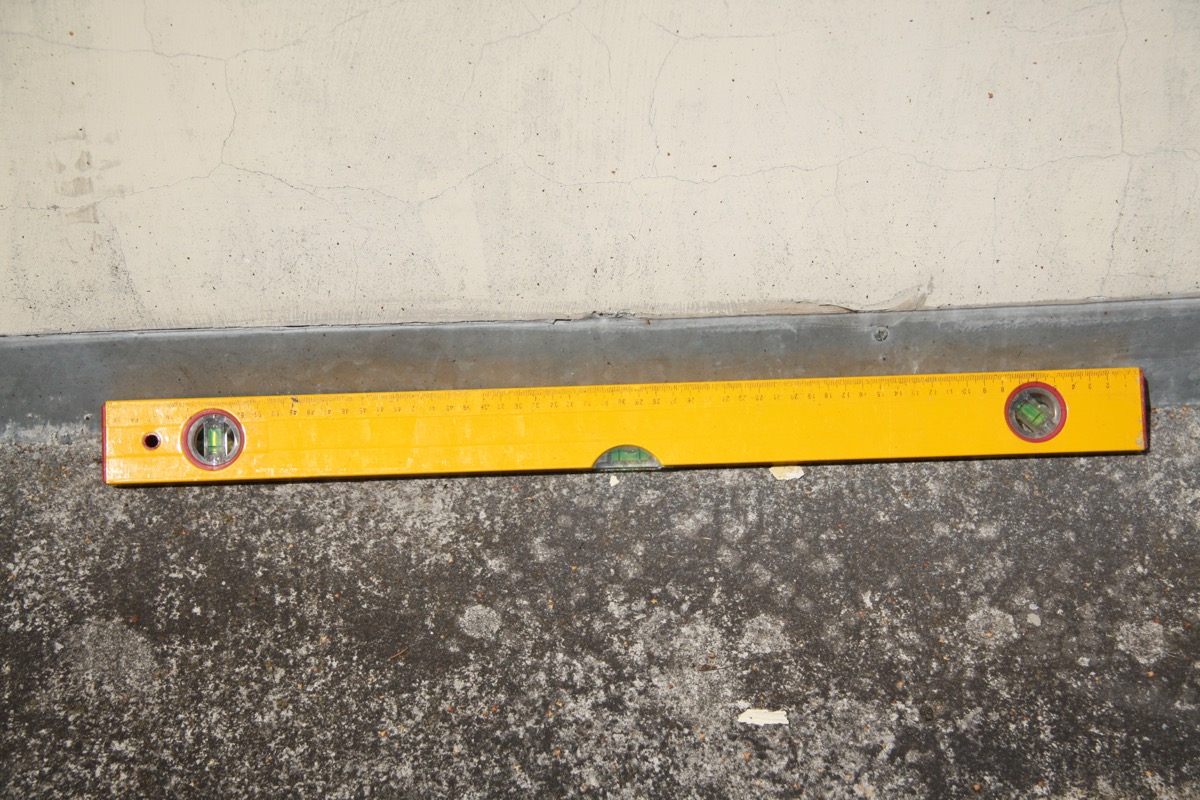
What to do when floors and walls are out of level
Most kitchens are out of level, and most need a shim thicker than 3/8 inch somewhere on a base run. The reference line handles the floor by design. Walls are a separate problem. A wall that leans in or out throws off upper cabinet plumb and decides whether the doors sit still or swing on their own.
Shimming base cabinets on uneven floors
The reference line takes care of the floor for you. Shim each cabinet up to the line. On a bad floor some cabinets need 3/4 inch of shim or more. Use composite shims for anything over 1/4 inch. Wood shims compress and dry out, and the cabinet settles out of level months later.
Out-of-plumb walls and upper cabinets
A wall that leans into the room lets the upper doors swing open. A wall that leans away lets them swing shut. Check the wall for plumb with your phone before you hang anything. If it is off by more than about 1/4 inch over 8 feet, shim the cabinet off the wall at the top or bottom of the mounting rail to bring the face plumb on its own, no matter what the wall does.
Filler strips and scribe molding
A gap between the end cabinet and a wall, or between the cabinet tops and an uneven ceiling, is normal. A filler strip of matching cabinet material closes the side gap. Scribe molding is a thin flexible strip you plane or cope to follow an uneven ceiling or wall, and it covers the gap at the top. Neither one means bad work. Both are standard finish work.
Why the front face matters more than perfect level
Here is the part DIYers tend to miss. Cabinets do not have to be dead level in an absolute sense. What they need is for all the front faces to sit in one flat plane. A cabinet that is a third of a degree off but flush with its neighbors looks and works fine. A cabinet that is perfectly level but stands a millimeter proud of the next one looks wrong, and you feel it every time you open the door.
The rule: Even a small step between two adjacent face frames shows as a ridge or gap at the joint. That is tighter than what the cabinet itself has to meet, but it is what the eye actually catches. Clamp the face frames together, check them flush with a straightedge, and screw before you unclamp.
So there are times you shim a cabinet a touch off level on purpose to keep its face flush with the one beside it. If the floor rises 3/8 inch over the width of two cabinets and both faces have to line up, one of them ends up fractionally off level and still well inside face frame spec. That is the right call, not a compromise. The face is what people see.
The most common cabinet installation mistakes
Most jobs that go wrong trace back to one of five mistakes made in the first hour. Fixing them after the cabinets are screwed in is slow and expensive. There is a reason a good installer spends so long on that first corner cabinet: everything after it hangs off that one.
- Skipping the high point. Start at the low spot and every cabinet after it needs more shim than the last. The run slopes down toward the starting corner, and that shows the moment the countertop goes on.
- Screwing into drywall instead of studs. Drywall anchors are not rated for a loaded cabinet with a countertop and full drawers on it. Every screw goes into a stud. If a stud lands mid-cabinet with nothing to catch, add a horizontal mounting strip across the studs first.
- Checking level before shimming. Set the cabinet roughly in place, then check, then shim. Shim first and you are working blind and re-checking anyway. The order is position, check, shim, re-check, screw.
- Using wood shims for big gaps. Wood dries out and compresses. A thick wood shim can lose a fair bit of its thickness over the first year in a heated kitchen and drop the cabinet out of level. Composite shims hold. Use them for anything over 1/4 inch.
- Not protecting the floor. A cabinet base dragged over a bare floor scratches hardwood and chips tile. Lay cardboard over the whole work area before the first cabinet comes in. Five minutes there saves a big floor repair bill.
Document every cabinet reading with Spirit Level Pro's journal — photo proof for your records.
Open Spirit Level ProFrequently asked questions
How level do kitchen cabinets need to be?
Tighter than most people expect. The cabinet industry standard allows only about 1/32 inch of misalignment between face frames, which works out to a fraction of a degree across a cabinet. Aim for about a third of a degree on each face with a Finish tolerance preset and you will catch any gap the eye would pick up.
What is the standard height for base cabinets?
Base cabinets stand 34.5 inches to the top of the box. A countertop adds about 1.5 inches, so the finished work surface lands at 36 inches. On an uneven floor you set a level reference line at 34.5 inches above the floor's high point and shim each cabinet up to it.
Can I install kitchen cabinets by myself?
You can do the base cabinets on your own without much trouble. Uppers are the hard part alone, since you have to hold them at height while you drive screws. A ledger board screwed to the wall at the right height holds the cabinet for you. Plenty of pros still use two people on uppers, but the ledger method works well solo.
What happens if kitchen cabinets are not level?
The errors pile up. Doors and drawers stop lining up and may not close right. The countertop rocks or needs heavy shimming at the seam. Even a small tilt on a wide base cabinet shows as a slanted countertop edge or a gap at the toe kick, and once you see it you cannot unsee it.