Measuring Slope Angles for Stair Handrails and Ramps
A stair handrail runs at the same angle as the stairs, which lands between 30° and 38° for most stairs the code allows. An ADA ramp cannot be steeper than 1:12. That is 4.76°, or 8.33%. These are code minimums, not suggestions. Miss the angle and you get sent back to redo it. Your phone reads both angles and keeps a record of them.
- A handrail runs parallel to the stair pitch. On a stair the code allows, that puts it somewhere between 30° and 38°.
- The ADA ramp maximum is 1:12. That equals 4.76°, 8.33%, or 83.3mm/m.
- Handrails matter because they give people something solid to catch when a foot slips on the stairs.
- Set the Target Angle to your measured stair pitch, then check each bracket reads zero deviation.
- Measure ramp slope at the top, middle, and bottom on their own. A ramp can sag in the middle and pass at both ends.
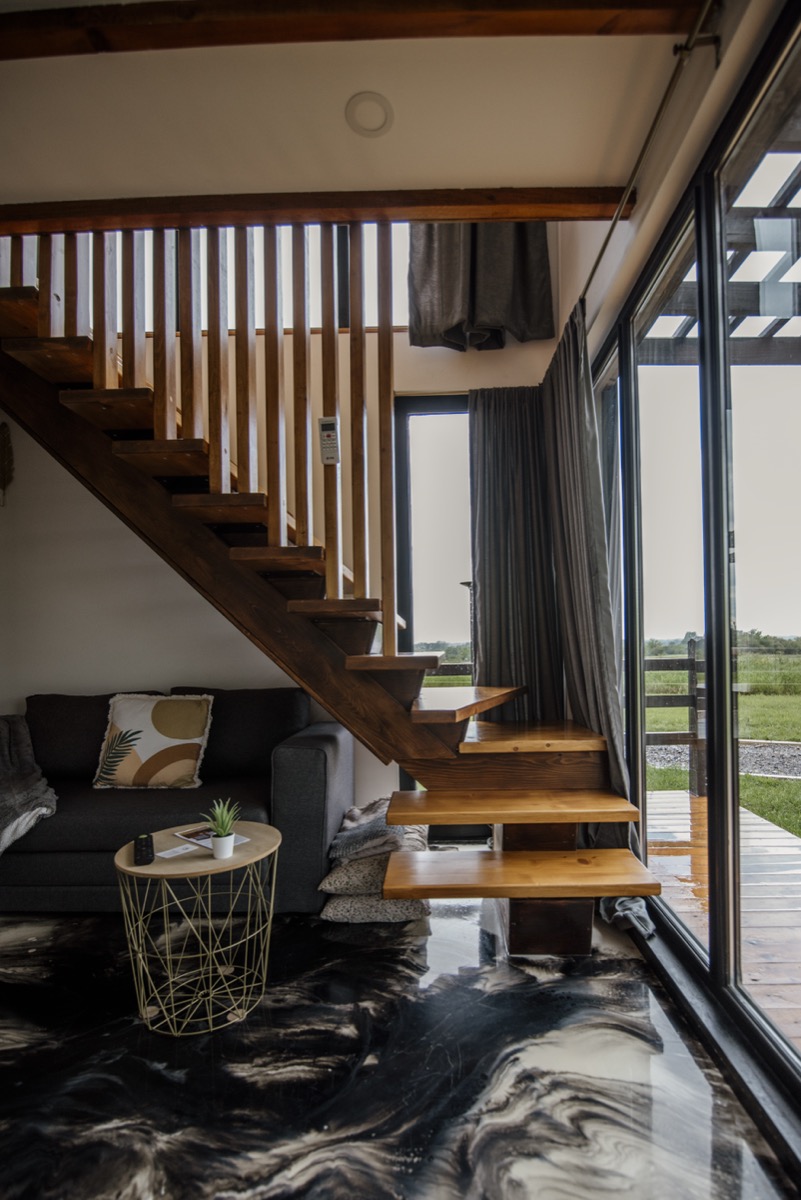
Why are handrail and ramp angles in the code?
People fall on stairs all the time, and a handrail is what they grab on the way down. That is the whole point of it. A rail set too steep or too shallow is awkward to hold and does not give a hand the purchase it needs when a foot goes out from under someone.
The angle rule follows from that. A rail that runs parallel to the stairs stays the same height above every tread, so a hand sliding down it never has to reach up or hunch over. The IBC wants the rail continuous for the whole stair, 34 to 38 inches above the nosing, and parallel to the slope. Set a bracket outside the 30 to 38 degree range and you lose that even height.
Ramps come from a different place. A 1:12 slope is about as steep as someone in a wheelchair can push up on their own. Any steeper and they need a motor or a helper, which is the opposite of what an accessible route is for. OSHA carries the handrail rules onto construction sites as well, so a temporary stair needs a proper rail the whole time it is in use.
Where does the 30 to 38 degree range come from? Not the handrail rule itself. The handrail just has to match the stairs. It comes from the stair rules: risers of 4 to 7 inches and treads of at least 11 inches. Run those numbers and the steepest stair the code allows lands around 38 degrees, the shallowest around 30. A rail parallel to any stair in that band sits in the same band.
What the IBC and ADA actually require
Three sets of rules cover stairs and ramps in most of the US. The IBC covers commercial buildings and is the one most states adopt. The ADA standards cover anything the public uses. OSHA covers construction sites. For houses, the local code usually points at the IRC, which uses the same handrail range as the IBC.
| Standard | Requirement | Value | Notes |
|---|---|---|---|
| IBC Section 1011.11 | Handrail angle range | 30° - 38° | Parallel to stair slope |
| IBC Section 1011.11 | Handrail height above nosing | 34″ - 38″ | Measured vertically |
| ADA Section 405.2 | Max ramp slope | 1:12 (4.76° / 8.33%) | Hard maximum - no exceptions |
| ADA Section 405.3 | Max ramp cross-slope | 1:48 (2.08%) | Perpendicular to direction of travel |
| ADA Section 505.5 | Handrail graspability diameter | 1.25″ - 2″ | Round or graspable profile |
| ADA Section 405.7 | Landing at top and bottom of ramp | 60″ min length | Must be level (≤1:48 in all directions) |
| OSHA 1926.1052(b)(1) | Construction site stair handrails | 30° - 50° from horizontal | Wider range for temporary stairs |
| Canadian NBC | Handrail angle (reference) | 20° - 45° | National Building Code of Canada |
Notice OSHA's site range (30 to 50°) is wider than the IBC's building range (30 to 38°). A temporary site stair can be steeper than a permanent one is allowed to be. So know which rule applies to the job before you set a bracket.
How to measure stair pitch to set the handrail angle
The handrail angle is the stair angle. The rail has to run parallel to the stairs, so if the stairs sit at 34°, the rail sits at 34°. The quick way to find the stair angle is to lay your phone flat on a tread and read it. That beats working out rise over run with a tape, and it beats fussing with a bevel gauge.
Open spiritlevel.pro and check you are in degrees mode. The unit chip by the tolerance row shows the current unit. Tap it until it reads degrees. Lay the phone flat on a tread, pointing the way you walk up. Give it two seconds to settle. That reading is your stair pitch. Write it down. It is the target for your brackets.
The treads should all read the same. The code only allows 3/8 inch of difference between the tallest and shortest riser in a flight. In an old house you will often find half an inch or more. So check three or four treads. If they vary by more than a degree, the stair itself has a problem, and that has to be sorted before the handrail will pass.
-
Open the app in degrees mode.
Tap the unit chip in the tolerance row until it reads degrees. Then the number lines up straight against the 30 to 38° range, no math.
-
Lay the phone flat on a tread, pointing the way you walk up.
Not on the riser, not on the landing, not on the nosing edge. Only the flat of the tread reads the real pitch. Give it about two seconds to settle.
-
Read three or four treads and take the average.
They should hold within half a degree of each other. More spread than that means the riser heights are off, which is a stair problem you fix before the handrail.
-
Set Target Angle to the pitch you measured.
Now the bubble, the audio, and the deviation readout all work against your stair's angle instead of zero. Hold the phone on a bracket and zero deviation means the bracket matches the stairs.
-
Save the tread readings with photos in the journal.
That gives you a dated record of the stair pitch before you touch a bracket, which is handy if an inspector later asks how you picked the angle.
spiritlevel.pro reads stair pitch in degrees. Set the Target Angle to that pitch, then bring each bracket to zero deviation. The journal saves a GPS tag and photo with every reading for your permit file.
Open spiritlevel.proHow to set handrail brackets to the right angle
There are two ways to set an adjustable bracket. One uses the stair pitch you already measured. The other targets 34°, the middle of the code range, and checks the rail against that. Which you reach for depends on whether you are hanging new rail or checking rail somebody else put up.
Method 1: match the stair pitch
Use this when you have the stair pitch and want each bracket to sit at it exactly. Hold or clip the phone to the rail or against a bracket. With Target Angle set to your measured pitch, work the bracket pivot until the app reads zero deviation. The rail is now parallel to the stairs. Tighten the hardware, save a photo, move to the next bracket.
Method 2: target 34°
Use this on a new install before you have measured the individual stair, or to check a contractor's work against the middle of the code range. Set Target Angle to 34° and hold the phone on the installed rail. The readout tells you how far the rail sits from center. Within 4° either way passes. More than that and the bracket is outside the 30 to 38° range and has to move.
Method two catches a trap that method one walks right into on old stairs. A staircase from the 1950s might run at 42°, steeper than the code allows a permanent stair to be. Match a rail to that 42° stair and it passes the parallel test but fails the angle test outright. So check against the code numbers, not just the stairs in front of you.
How to measure a ramp slope for the ADA
The ADA ramp maximum is 1:12, which is 4.76° or 8.33%. Percent mode reads it straight off. Set the phone on the ramp and read the percentage. Anything over 8.33% is too steep. The cross-slope, measured across the direction of travel, cannot go past 1:48, or 2.08%.
When you pour a new ramp, aim for 1:14 to 1:16, not 1:12. That gives you room for the concrete to settle and the pour to wander a little without ending up over the line. A ramp poured right at 1:12 almost always reads steeper somewhere once the forms come off. Grinding a cured slab is slow and grim, so build the margin in.
Check the landings while you are at it. The ADA wants a landing at the top and bottom of every run, at least 60 inches long, sloping no more than 1:48 in any direction. A landing that looks flat can still read 2 to 4% on a wet day because it was graded to shed water. Landings fail ADA ramp inspections all the time for exactly this.
Which slope unit to use
Every trade writes slope differently. The ADA gives ramps as a ratio, 1:12. OSHA talks in degrees. Engineers use percent. It is all the same angle, just written four ways depending on who drew the spec. That is where mistakes come from. A slope written "8.33" means one thing as a percent and something completely different as degrees.
| Unit | ADA Max Ramp (1:12) | IBC Handrail Min (30°) | IBC Handrail Max (38°) |
|---|---|---|---|
| Degrees | 4.76° | 30.00° | 38.00° |
| Percent (%) | 8.33% | 57.74% | 78.13% |
| mm/m | 83.3 mm/m | 577 mm/m | 781 mm/m |
| in/ft | 1″/ft | 6.93″/ft | 9.37″/ft |
| Ratio (1:N) | 1:12 | 1:1.73 | 1:1.28 |
spiritlevel.pro carries all six slope units and cycles them with one tap on the unit chip. On a ramp, use percent or ratio so you read straight against the ADA spec. On a handrail, use degrees so you read straight against the 30 to 38° range. No conversion in your head. Just match the unit the code reference uses.
How to document angles for the permit and inspection
An inspector checks a handrail or ramp by measuring the angle at a few points and seeing that each one falls in range. If you hand over your own readings first, with photos, angles, and a timestamp on each, the inspector spends less time on site and you have a record if anyone questions the work later.
The Pro journal saves each reading with a photo, a GPS tag, and the time. Take one at the top, middle, and bottom of every ramp run, and one at each bracket. Then export a PDF report that lays them all out in order and email it to the building department before the appointment.
The GPS tag pulls its weight on ADA audits. It shows a consultant that you measured along the ramp, not just at the two easy ends. On commercial and public jobs, that kind of record is more and more what people expect to see.
The angle mistakes that come up most
Most handrail and ramp failures are the same few every time. Catch them before you build and you save yourself the cost of doing it twice. Bad stair handrails are one of the things OSHA writes up most often on sites.
Handrail too steep
The usual one on new work. The bracket looks right against the stairs but reads over 38°. It happens when someone eyeballs the angle off a steep stair instead of measuring the pitch first. Measure the tread pitch before you set a bracket, then use Target Angle to check each one matches.
Ramp over 1:12 in the middle
A ramp can read under 8.33% at both ends and still fail if it sagged or crowned in the middle. That is the thing that sends ramps back for re-inspection more than anything. Check only the ends and you miss it. So take three or more readings on any run over 6 feet.
Landings that slope
A landing has to sit within 1:48, or 2.08%. Plenty get poured as flat slabs but graded to drain, and they end up at 1 to 3%, over the line. Pour landings apart from the run and read them before the concrete cures if you can. Once it is hard, grinding or an overlay is the only way back.
Handrail height wandering above the nosing
The code wants 34 to 38 inches above every tread nosing. Get the bracket angle right but the top rail not quite parallel and the height creeps as you go up the flight. Check the angle and the height at the first, middle, and last tread. A rail that measures fine at top and bottom but dips to 32 in the middle still fails.
Common questions about handrail and ramp angles
What angle should a stair handrail be set at?
The same angle as the stairs. The code wants the rail parallel to the slope, and most stairs it allows sit between 30° and 38°, with 34° in the middle. Measure your own stair pitch with a phone first, set the Target Angle to that, then bring each bracket to zero deviation.
What is the maximum slope for an ADA ramp?
1:12, which is 4.76°, 8.33%, or 83.3mm/m. The cross-slope cannot go past 1:48, or 2.08%. Build to 1:14 or 1:16 to leave room for the pour to settle. And read the top, middle, and bottom of every run on their own, since the middle often sags past 1:12 while both ends stay fine.
How do I measure stair pitch with a phone?
Lay the phone flat on a tread, pointing the way you walk up, and read the pitch in degrees mode. Not the riser, not the nosing edge. Read three or four treads and average them. Set that as the Target Angle. When you hold the phone on a bracket and it reads zero deviation, the bracket matches the stairs, which is what the code asks for.
What do I need for a handrail or ramp inspection?
An inspector wants angle readings at several points, photos of where the brackets sit, and the dates. The Spirit Level Pro journal saves each reading with a photo, GPS, and timestamp. Export a PDF that covers every point and send it to the building department before the visit. Handing over the numbers up front tends to get you through in one pass.
The handrail and ramp checklist
Every good handrail and ramp goes through the same short list of checks. Here it is, in the order that catches problems before they are built in.
- Measure the stair pitch: Degrees mode, three or four treads, take the average. Make sure it sits in the 30 to 38° range before you touch a bracket.
- Set the Target Angle: To your measured pitch, or 34° to check against the code middle. Each bracket should read zero deviation.
- Check the rail height above the nosing: 34 to 38″ measured straight up at the first, middle, and last tread. Right angle, wrong height, still fails.
- Read the ramp slope in percent: Top, middle, and bottom on their own. All under 8.33%, the 1:12 line.
- Read the ramp cross-slope: Turn the phone 90° on the surface. Under 2.08%, the 1:48 line.
- Read the landings: Under 1:48 in every direction. This is the one people miss most.
- Write it all down: Photo, GPS, and angle for each bracket and every ramp segment. Export the PDF before the inspection.