Tile Installation: How to Prevent Lippage and Keep Tiles Level
Lippage is the height difference between two tile edges where they meet at a joint. It is the callback I dread most, because by the time the customer notices it, the thinset has cured and there is no easy fix. ANSI A137.1 allows a maximum of 1/32in (0.8mm) of lippage for tiles that vary no more than 1/16in in thickness, and 1/16in (1.6mm) for tiles you have to back-butter. Staying inside that comes down to three habits: get the subfloor flat before you start, use the right trowel notch, and check every tile as you set it, not after the row is down.
- ANSI A137.1 caps lippage at 1/32in for standard tiles and 1/16in for back-buttered tiles.
- ANSI A108.02 wants the substrate flat within 3mm over 3 meters for standard tile, and 1.5mm over 3 meters for large-format tiles (15in or more on any side).
- Tile leveling clips flatten a bowed tile face against its neighbor. They do nothing for a floor that is out of plane.
- The TCNA Handbook wants at least 80% mortar coverage under every tile, and 95% in wet areas.
- You get about 2 minutes to move a tile before the thinset skins over.
What is tile lippage and why does it happen?
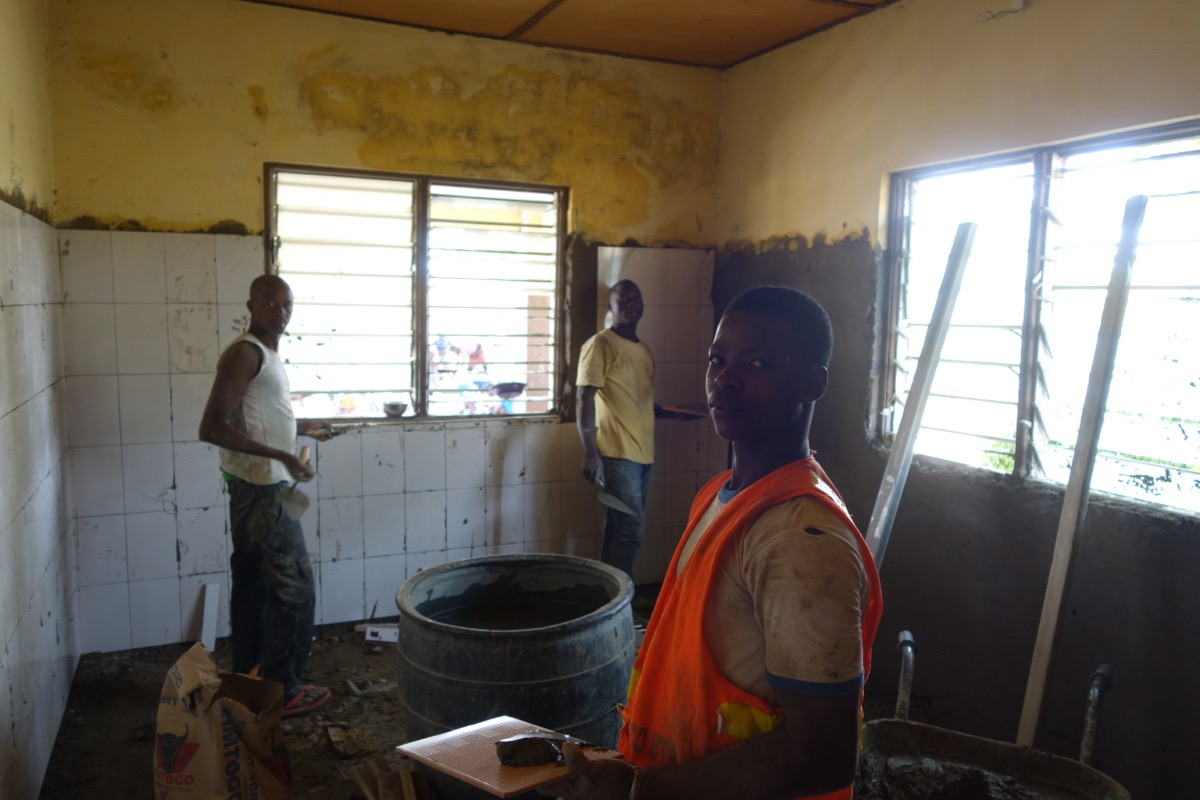
Lippage is the height difference between two tiles where they meet at a grout joint. It is the complaint I hear about most, and it is behind most of the warranty arguments in this trade. Even a small 1/16in step catches the light and catches a toe. Run your hand across a finished floor and you can feel it before you can see it.
The causes are not a mystery. An uneven substrate is the big one. If the floor is not flat before the tiles go down, no amount of skill saves you afterward. After that it is thin mortar coverage that lets tiles flex over voids, natural bow in the tile face on large-format porcelain, tiles that never got pressed fully into the bed, and big tiles rushed off before they were properly beaten in.
Warped tiles are their own headache. Large-format porcelain often comes with 1/16in to 1/8in of bow across the face, and that is within what the maker allows. The bow shows up as a lip at every joint. That is the reason tile leveling clips exist. Their job is to hold one tile face flush with the next. They do nothing about a floor that is out of plane.
What do the ANSI standards actually require?
Two ANSI standards cover tile work head-on. ANSI A137.1 covers the tile itself, including how much warp is allowed and the lippage limits above. ANSI A108.02 covers the install, including how flat the substrate has to be before you set a single tile. Between them they set the baseline every US tile job is measured against.
| Standard | Requirement | Value | Notes |
|---|---|---|---|
| ANSI A137.1 | Max lippage (standard tile) | 1/32″ (0.8mm) | Tiles ≤1/16″ thickness variation |
| ANSI A137.1 | Max lippage (back-butter required) | 1/16″ (1.6mm) | Tiles requiring back-buttering |
| ANSI A108.02 | Substrate flatness - standard tile | 3mm per 3m | ~1.0 mm/m slope equivalent |
| ANSI A108.02 | Substrate flatness - large-format (≥15″) | 1.5mm per 3m | ~0.5 mm/m - twice as strict |
| TCNA Handbook | Minimum mortar coverage | 80% dry / 95% wet | Per tile, measured after pull-test |
| ADA Standards | Max vertical change in level | 1/4″ at transitions | Applies at floor transitions and thresholds |
In plain terms: if the substrate reads above 1.0 mm/m on a phone slope check, it is outside ANSI A108.02 for standard tile before you lay a single piece. For large-format tile the line drops to 0.5 mm/m. Most floors that look flat fail this in a few spots.
Step 1: check and prepare the substrate
ANSI A108.02 wants the substrate flat within 3mm over any 3-meter span for standard tile, and within 1.5mm over 3 meters for large-format tile with any side 15 inches or more. That is tight. Most subfloors in a house need at least some work before tiling. The only way to know where the trouble is hiding is to check it point by point on a grid.
Open spiritlevel.pro in your phone browser. Tap the unit chip and switch the slope unit to mm/m. Pick the Tile preset (±0.2°). Walk a 2-foot grid across the whole area. Set the phone flat at each intersection and give it two seconds to settle. Chalk the mm/m number on the floor where you took it. Anything above 1.0 mm/m in a standard tile area, or above 0.5 mm/m in a large-format area, gets fixed before you go on.
People are always surprised how many spots fail. A floor that looks flat and feels flat underfoot will throw a 2 to 4 mm/m reading near the walls and doorways, which is exactly where the edge tiles catch the light and show a lip. Finding those before the tile order shows up saves you days of grinding and pouring later.
-
Walk the grid in mm/m mode.
Chalk a 2-foot by 2-foot grid across the floor. Take a reading at every intersection. Circle anything over 1.0 mm/m for standard tile, or 0.5 mm/m for large-format, in red.
-
Find your high and low spots.
The highest reading in the room is your datum. Every low spot has to come up to within 3mm of that point over any 3-meter run. On a slab you can only add material without a lot of grief, so plan around the high points.
-
Prep the surface.
Grind concrete high spots down with a diamond cup wheel. Screw off any loose plywood, one screw every 6 inches across the field. Prime wood before you pour.
-
Pour self-leveling compound.
Low spots up to about 1.5 inches deep take one lift. Deeper areas need more than one. Let it cure right through before you re-test. Give it a few hours to walk on and a full day before you tile.
-
Re-check after it cures.
Walk the grid again in mm/m mode. Every spot you fixed should read within tolerance now. Save the readings with photos in the journal. That is your pre-installation baseline on record.
spiritlevel.pro runs in your phone browser, no download. Pick the Tile preset (±0.2°), switch to mm/m, and map every bad spot before you order materials. The journal saves each reading with a photo.
Open spiritlevel.proHow do you pick the right mortar and trowel notch?
The TCNA Handbook wants at least 80% mortar coverage under every tile in dry areas, and 95% in wet areas, showers, and outside. Trowel notch size decides how much mortar ends up on the back of the tile. Pick a notch too small for the tile and you starve the coverage, the tile flexes over the voids, and the lip shows up later.
The rule is simple: match the notch to the tile. Small tiles up to 8 inches take a 3/16-inch V-notch or a 1/4-inch square-notch. Medium tiles, 8 to 15 inches, take a 1/4 by 3/8-inch square-notch. Large-format tiles with any side over 15 inches need a 1/2-inch square-notch or bigger, and on those you have to back-butter. ANSI A137.1 calls for it at that size. Back-buttering is just skimming a thin coat of mortar onto the back of the tile so it makes full contact.
Mortar choice matters on big tile too. Plain thinset shrinks as it cures and can tug at a large unsupported face. Medium-bed mortars, good up to about 3/4-inch thick, are made for large tile. They hold up without slumping and do not shrink the same way. Check the bag for the largest tile size it is rated for before you mix.
Do tile leveling systems actually work?
Tile leveling systems, whether T-clips, Raimondi, Spin Doctor, or one of the others, do the job they are built for. That job is pulling a bowed tile face flush with its neighbor while the mortar sets. On tiles with a couple of millimeters of bow they get you close to no lip at all. What they will not do is fix a floor that is out of plane.
Here is how they go in. Slide the base clip under the tile before you set it, put the tile in place, then push the wedge or cap down over the clip. It stops the tile shifting sideways or up and down against its neighbor while the thinset cures. Next day, knock the sticking-up part off with a rubber mallet. The tab is made to snap clean at the tile surface.
Here is something the clip instructions never mention. Do not put a clip within 2 inches of a joint where the next tile is from a different box lot. On large-format porcelain, different production runs can sit half a millimeter to a millimeter apart in thickness, and no clip bridges that. Check the lot numbers before you mix boxes in the same field.
How do you monitor level while you set tile?
Checking each tile as you set it, not after the whole row is down, is the thing that separates a clean floor from a callback. You get about 2 minutes in normal conditions before the thinset skins over and moving the tile starts to break the bond. Use that window. Set the tile, beat it in, check it. If it is out, fix it now.
Pick the Tile preset (±0.2°) in spiritlevel.pro. Surface mode reads pitch and roll at the same time, which is what you want on a big tile bridging a couple of dips in the substrate at once. Set the phone on the tile inside 30 seconds. The audio beeps faster as you close in on level, so you can keep both hands on the tile and go by ear.
Work small. In warm weather do not set more than 9 to 12 square feet before you check it. Mix mortar in smaller batches too. A bucket left open 20 minutes on a hot day goes stiff even when it still looks fine. Wasted mortar is cheap. Pulling up cured lippy tile is not.
What about lippage at transitions?
Where two different surfaces meet, lippage becomes its own problem. The ADA Standards for Accessible Design cap the vertical change in level at 1/4 inch (6.4mm) at any floor transition, and anything between 1/4 inch and 1/2 inch has to be beveled at no steeper than 1:2. A vertical lip over 1/4 inch is a trip hazard in any busy or public space.
Tile-to-hardwood and tile-to-carpet are the usual trouble spots because the two surfaces sit at different heights. A 3/8-inch porcelain tile on a 1/4-inch bed does not land level with 3/4-inch hardwood on plywood. You pick the transition strip to bridge that gap. Schluter Reno-T, reducer strips, and T-moldings each cover a different height combo. Measure both finished surfaces before you order the hardware.
For tile-to-tile between rooms sitting at different subfloor heights, common in older houses with an added-on room, work the mortar bed thickness out to match the heights before you set anything. Building a bed up 3mm is easy. Grinding down a cured floor is not.
How do you keep wall tiles plumb and level?
Wall tile adds a vertical run that floors do not have. Start a course 1mm out at the base and by the 10th course you are 10mm out, and it shows against any countertop edge or horizontal line. So you snap a level chalk line for your starting reference, check it with a level, and never trust the floor or the countertop to be level enough to tile off.
On a big feature wall the pyramid method works well. Find the center, drop a plumb line with the phone in Plumb mode, and work out from there in both directions. The cuts come out even on both ends and the pattern stays symmetrical. Check plumb every 3 or 4 courses, because mastic lets tiles creep down the wall before it grabs.
Starting off a level chalk line instead of the floor is worth the two minutes it takes. On a wall over a floor that is 3 to 5mm out, that line is the difference between a course that reads straight and one that drifts. The floor looks fine. It almost never is fine to the tolerance tile needs.
Frequently asked questions about tile lippage
What is the maximum allowable tile lippage per ANSI standards?
ANSI A137.1 caps lippage at 1/32in (0.8mm) for tiles that vary no more than 1/16in in thickness, and at 1/16in (1.6mm) for tiles you have to back-butter. That limit applies at every grout joint. Go past it and you have a defect, and possibly a trip hazard, since the ADA caps the vertical change in level at 1/4in at any floor transition.
Do tile leveling clips fix an uneven subfloor?
No. Clips pull a bowed tile face flush with its neighbor. They do nothing for a substrate that is out of plane. ANSI A108.02 still wants 3mm flatness per 3m for standard tile and 1.5mm per 3m for large-format. If the floor fails that, you pour self-leveling compound before you set any tile, whatever clip system you had in mind.
How do I check substrate flatness before tiling?
Open spiritlevel.pro, switch to mm/m, and pick the Tile preset (±0.2°). Walk a 2-foot grid across the floor and chalk the reading at each point. Anything over 1.0 mm/m fails ANSI A108.02 for standard tile. Over 0.5 mm/m is a problem for large-format. Save the readings with photos in the journal so you have a pre-installation record for the client.
How long do you have to adjust a tile after setting it in thinset?
About 2 minutes in normal conditions, say 65 to 75°F and moderate humidity. Hot and dry, and you might have 90 seconds. Once the thinset skins over, moving the tile breaks the bond. Work small, 9 to 12 square feet at a time, and check level within 30 seconds of setting each tile while the mortar is still soft.
The tile installation level checklist
A clean tile job runs the same order every time. Skip a step and you can guess which defect turns up. Here is the whole thing, prep through set, in the order you do it.
- Check substrate flatness: mm/m grid every 2 feet. Fix anything over 1.0 mm/m for standard tile, 0.5 mm/m for large-format. Photograph the readings.
- Pick the trowel: notch to tile size. Large-format (15in or more) needs a 1/2-inch square-notch at least.
- Back-butter the large-format tiles: ANSI A137.1 calls for it on anything 15in or more on a side.
- Pull-test the first tile: lift it after 30 seconds and check coverage. Minimum 80% dry, 95% wet, per TCNA.
- Check every tile: set, beat in, read it with the phone on the Tile preset inside 2 minutes. Fix it before the thinset skins.
- Clip the bowed ones: leveling clips on all large-format or bowed tiles before the thinset skins over.
- Plan the transitions: measure the finished height on both sides before ordering strips. ADA caps the vertical change at 1/4in.
- Log it in the journal: photo, GPS, and angle for each section, for the client record.